

My AC is leaking water.
In cooling mode, an AC unit removes moisture from the air. This water, the condensate, has to leave through a drain pipe: when it drips in the wrong place, the cause is almost always along that path.
Updated on 27 October 2026
First, switch the unit off
If water is running down the wall or onto furniture, switch the AC off to limit the damage (Heiwa). The dripping water has nothing to do with the refrigerant gas: it is condensate (Heiwa).
Where the water comes from
In cooling mode, the water forms in the indoor unit, whether wall-mounted, floor console, cassette or ducted. The pipe that drains it must slope down steadily, without rising or bending (Atlantic).
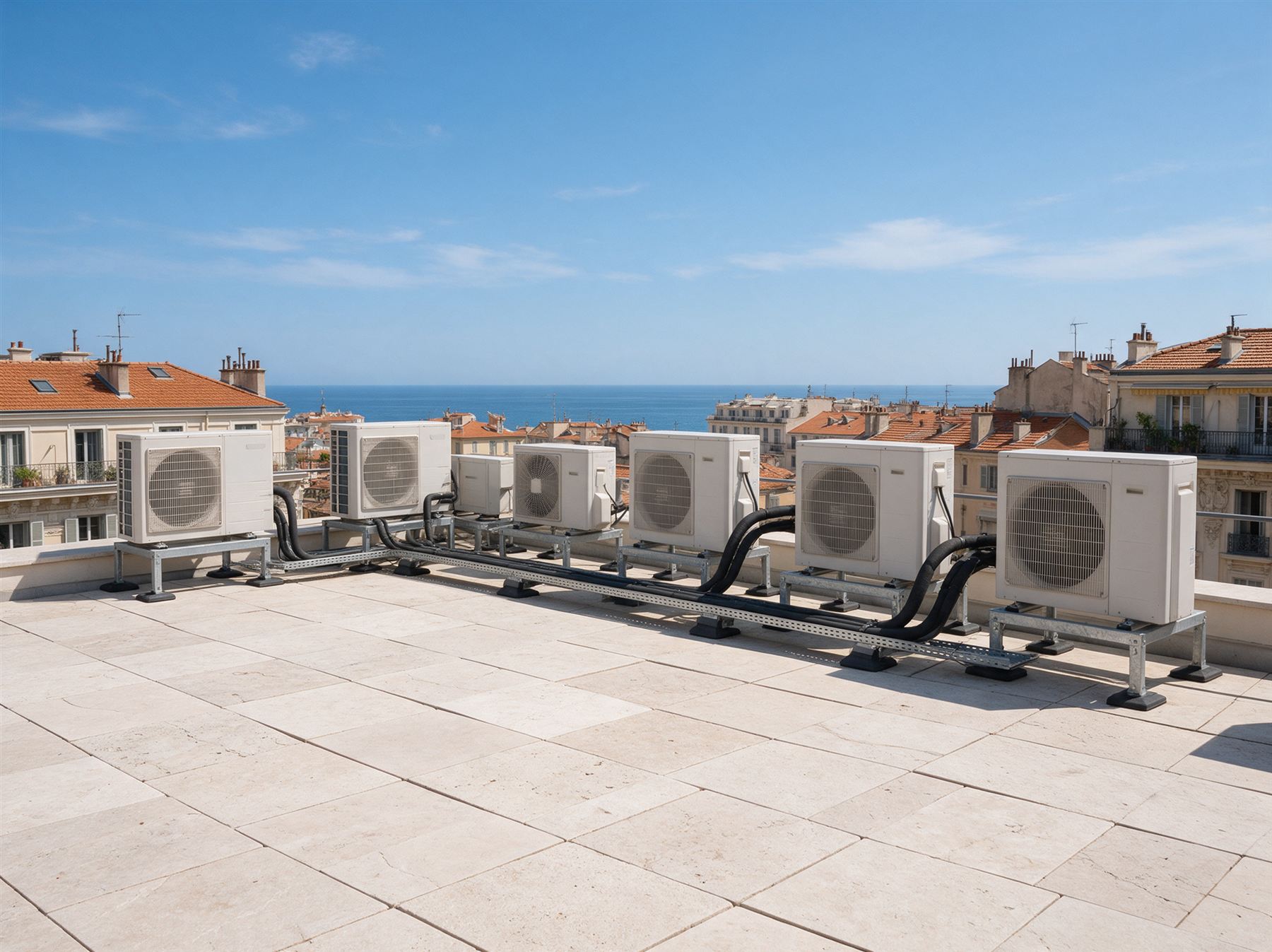
In heating mode, it is the outdoor unit that produces water: this is normal. It must be raised by at least 5 cm so the water can drain. When the outdoor temperature is 0°C or below, do not touch the drain plug or pipe, to avoid freezing (Atlantic).
The most common causes
- The condensate tray or drain pipe is blocked: dirt builds up over time, and the tray overflows because it cannot empty fast enough (Heiwa).
- The pipe has lost its slope, rises, bends or is pinched (Atlantic, LG).
- The pipe is loose or damaged at its connection (LG).
- If the unit has a condensate pump, it is unplugged or its level sensor is stuck (LG).
- A poorly insulated refrigerant pipe gets covered in condensation: this is an installation fault, to be put right by a professional (Heiwa).
A few drops around the air outlet, without a real leak, often come from the humidity in the room. LG then advises keeping windows and doors closed, opening the air louvres wider and increasing the fan speed.
What you can check yourself
- The drain pipe, where it is visible: a continuous slope, with no rise, bend or pinch (Atlantic).
- If the water drains into a container, empty it regularly so that the end of the pipe does not sit in water (LG).
- If the drain runs through a trap, clean it regularly (Atlantic).
- The filters: clean, or replaced as the manual says. ADEME recommends cleaning or replacing them every six months.
Atlantic also describes a test: gently pour a little water into the coil with a squeeze bottle; it should come out through the drain pipe. If the unit has to be opened for this, leave it to a technician.
What the technician does
They open the unit, clean the condensate tray, unblock the drain pipe, then pour in water to check that it only drains through the pipe (Heiwa). Depending on the case, they also check the pipe's slope (Atlantic), the condensate pump (LG) and the pipe insulation (Heiwa).
An AC unit that leaks while cooling poorly may be short of refrigerant: LG then advises calling a professional. Our guide AC no longer cooling covers this case.
At every air conditioning service, we check that the water drains properly, to avoid drips down the wall and bad smells. If water is already dripping, it is an air conditioning repair: we work in Nice, the Alpes-Maritimes, Monaco and the Var (on quotation), Monday to Saturday, 8 am to 6 pm.
Sources
- Atlantic, « Comment vérifier le bon écoulement des condensats de ma pompe à chaleur air air Atlantic ? », updated on 25 October 2026, accessed on 27 October 2026 (in French).
- Heiwa, « Pourquoi mon climatiseur coule ? », 20 May 2020, accessed on 27 October 2026 (in French).
- LG, « Pourquoi l'eau goutte-t-elle ou la condensation se forme-t-elle sur le climatiseur ? », online help (in French), accessed on 27 October 2026.
- ADEME, « Comment garder son logement frais tout l'été ? », guide, September 2026, accessed on 27 October 2026 (in French).